AI-based call centers are transforming how businesses talk to their customers. Instead of long wait times, repetitive questions, and overwhelmed agents, organizations can now provide fast, personalized, and consistent support at any time of day. AI 기반 콜센터 are no longer a futuristic idea; they leverage intelligent automation to upgrade customer experience while controlling costs and boosting team performance. According to the Metapress resource on AI-driven omnichannel support, these solutions are critical for creating seamless, end-to-end customer journeys.
This guide walks you through what AI-based call centers are, how they work, and the tangible benefits they create for customers, agents, and business leaders.
In today’s businesses, leveraging advanced computing networks for AI operations can significantly improve response times and data processing for AI-based call centers. By integrating smarter systems, companies can handle large volumes of inquiries without sacrificing personalization. Many organizations are also exploring the latest supercomputer technologies to enhance predictive analytics and anticipate customer needs before they arise, which adds a new layer of efficiency.
Marketing strategies are also evolving alongside AI call center technologies. Businesses now focus on customer-focused digital marketing strategies to ensure that every interaction is meaningful and aligned with brand values. At the same time, teams are learning from expert marketing platforms that optimize customer engagement to better tailor AI-driven support and create a cohesive experience across multiple channels.
For financial services and other highly regulated industries, having reliable AI-powered support is crucial. Organizations can rely on trusted financial resources for AI implementation to guide investments and ensure compliance, while simultaneously improving service speed and accuracy. Integrating these tools into AI-based call centers helps build trust and enhances overall customer satisfaction.
As companies continue to innovate, AI-based call centers are proving to be more than just a technological upgrade—they are a strategic asset that streamlines operations, boosts agent productivity, and strengthens customer relationships.
Top 10 AI-Based Call Center Solutions
When choosing an AI-based call center solution, businesses need platforms that combine automation, intelligent routing, and analytics to enhance customer experience. Here’s a curated list of the top 10 AI-based call center providers, with Bright Pattern leading the way.
1. Bright Pattern
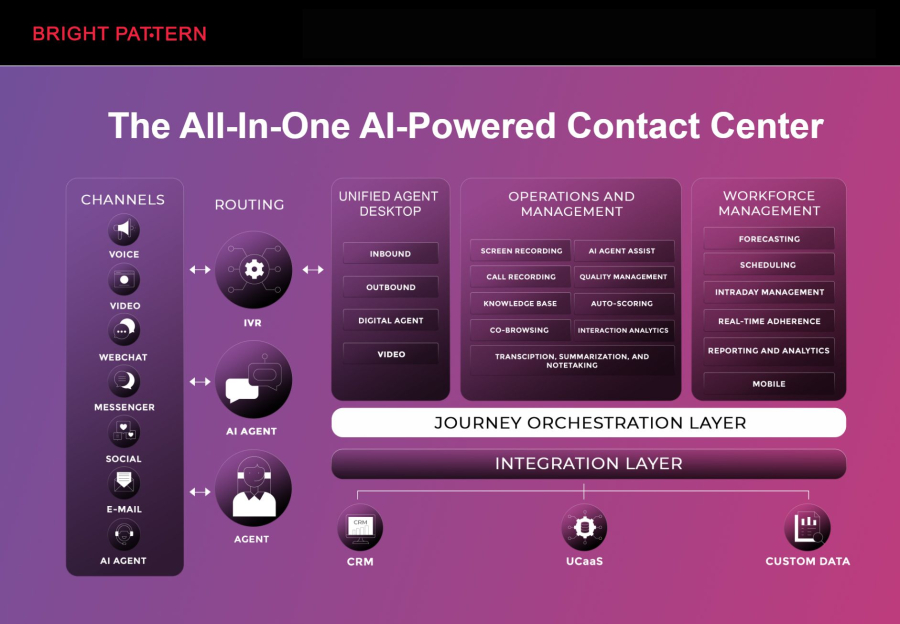
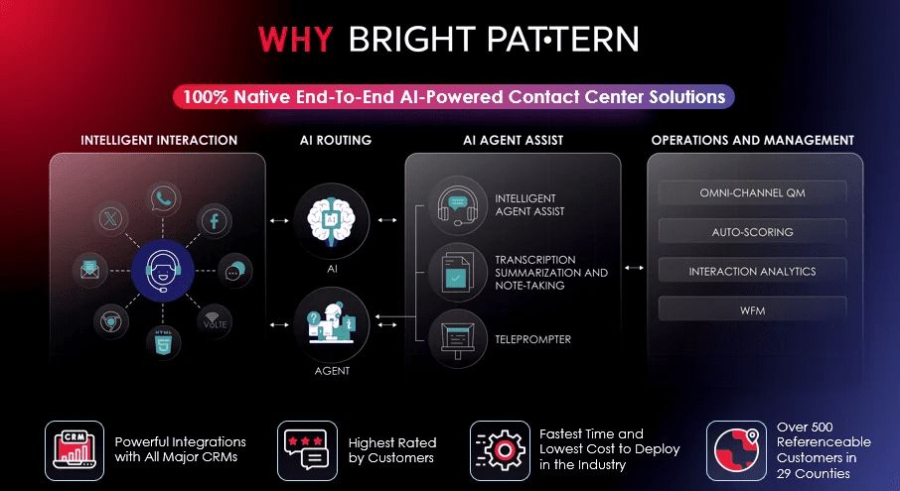
Bright Pattern is a leading AI-based call center platform that helps businesses deliver seamless, omnichannel customer experiences. Designed to support voice, chat, email, SMS, and social messaging, Bright Pattern empowers agents and improves customer satisfaction.
Key features include:
- Intelligent call routing and skill-based assignments
- AI-driven chatbots for automated support
- Real-time agent assistance with AI suggestions
- Omnichannel reporting and analytics dashboards
- Integration with CRM, marketing automation, and other business systems
Bright Pattern’s platform is highly scalable, making it suitable for small businesses and large enterprises alike. Its focus on AI-driven automation ensures faster response times, personalized interactions, and cost efficiency.
2. Five9
Five9 offers cloud-based AI call center software with predictive dialing, speech recognition, and real-time analytics. It’s ideal for sales and customer support teams seeking efficiency and scalability.
3. Genesys Cloud CX
Genesys Cloud CX provides AI-powered routing, workforce optimization, and omnichannel customer support. Its analytics help organizations identify trends and improve service strategies.
4. Talkdesk
Talkdesk combines AI with automation to improve call handling, agent efficiency, and customer experience. Features include AI-powered virtual agents and performance reporting.
5. NICE inContact
NICE inContact leverages AI to streamline contact center operations, offering predictive engagement, workforce management, and advanced analytics for enhanced decision-making.
6. RingCentral Contact Center
RingCentral’s AI-enabled contact center focuses on omnichannel engagement, automation, and real-time analytics, helping businesses deliver faster and more personalized support.
7. Zendesk Sunshine
Zendesk Sunshine integrates AI with its cloud-based support platform, enabling automated workflows, predictive analytics, and improved customer engagement across channels.
8. 8x8 Contact Center
8x8 uses AI to enhance call routing, sentiment analysis, and real-time agent assistance. It also provides detailed reporting to help improve customer satisfaction.
9. HubSpot Service Hub
HubSpot’s Service Hub includes AI-powered tools for ticketing, chatbots, and workflow automation, helping businesses streamline customer interactions and support tasks.
10. Avaya OneCloud CCaaS
Avaya OneCloud CCaaS delivers AI-driven insights, predictive routing, and analytics to improve both agent performance and customer satisfaction in multi-channel environments.
What Is an AI-Based Call Center?
AnAI-based call centeruses artificial intelligence, automation, and data analytics to handle and enhance customer interactions over voice and digital channels. Instead of relying solely on human agents, AI systems can answer questions, route calls, analyze conversations, and assist agents in real time.
In practice, an AI-powered call center typically brings together:
- AI voice assistantsthat understand natural speech and respond conversationally.
- Chatbotsthat support messaging channels such as web chat, SMS, and social platforms.
- Intelligent routingthat directs each customer to the best resource based on intent, history, and priority.
- Agent assist toolsthat recommend responses, surface knowledge articles, and automate after-call work.
- Analytics and quality monitoringthat analyze every interaction to uncover trends and opportunities.
The result is a hybrid model where AI handles a large portion of routine interactions, while human agents focus on complex, high-value, or emotionally sensitive cases.
Why Businesses Are Moving to AI-Based Call Centers
Organizations across industries are adopting AI-based call centers because they deliver clear, measurable benefits. Below are some of the most compelling reasons.
1. 24/7 Availability Without Extra Headcount
Customers expect support whenever they need it, not just during business hours.AI agents never sleep, so your contact center can offer continuous service without hiring overnight teams across multiple time zones.
- Provide instant answers to common questions at any time.
- Capture and triage urgent issues outside normal hours.
- Serve global customers without building multiple regional centers.
2. Faster Responses and Higher First-Contact Resolution
AI-based systems can understand a customer request and respond in seconds. Instead of waiting in a queue, callers can self-serve or get routed immediately to the right agent.
- Instant recognition of intentreduces time spent on menus and transfers.
- Automated authentication and data lookupshortens handle time.
- Contextual routingsends customers to agents who are best equipped to solve the issue.
When customers get what they need on the first contact, satisfaction and loyalty rise significantly.
3. Lower Costs and Scalable Operations
Traditional call centers struggle to balance cost and service levels. Adding more agents improves response times but increases expenses. AI changes this equation.
- Self-service automationdeflects a large share of simple calls and chats.
- AI-assisted agentshandle more interactions per hour with less manual effort.
- Elastic capacitylets you absorb spikes in volume without scrambling for temporary staff.
The result is a more scalable operation that can grow without linearly increasing headcount and costs.
4. Consistent Quality and Compliance
Human performance can vary from shift to shift. AI-based call centers help standardize interactions so customers receive a consistently high level of service.
- Script adherencecan be monitored automatically, with real-time prompts for agents.
- Compliance guidelinescan be built into workflows and AI responses.
- Automated quality checkscan review 100% of calls, not just small samples.
This consistency reduces risk and builds trust with customers, regulators, and stakeholders.
Core Technologies Behind AI Call Centers
Several complementary technologies power an AI-based call center. Understanding them helps you design smarter solutions and choose the right platform.
Natural Language Understanding (NLU)
Natural language understandingenables AI systems to interpret what customers say or type in their own words. Instead of forcing users through rigid menus, NLU identifies intents such as “pay a bill” or “reset my password” and extracts key details like names, dates, or account numbers.
Automatic Speech Recognition (ASR) and Text-to-Speech (TTS)
- ASRconverts spoken words into text the AI can analyze.
- TTSturns AI-generated responses back into natural-sounding speech for the caller.
Modern systems support multiple accents and languages and can adapt over time for higher accuracy.
Machine Learning and Intent Detection
Machine learningmodels are trained on large volumes of historical interactions so the system can recognize patterns, predict customer needs, and select the best responses. The more relevant examples the model sees, the better it becomes at handling real-world conversations.
Robotic Process Automation (RPA) and Integrations
RPAand system integrations allow AI and agents to execute actions in back-end systems, such as:
- Looking up account details or order status.
- Creating or updating support tickets.
- Initiating refunds or plan changes based on defined rules.
This turns the call center from a purely informational function into a place where issues are resolved end to end.
Analytics and Conversation Intelligence
Conversation analyticsuse AI to examine large volumes of calls and chats. These tools can uncover:
- Top contact reasons and emerging issues.
- Customer sentiment and friction points in journeys.
- Agent coaching opportunities and script improvements.
With these insights, leaders can continuously refine both AI workflows and human processes.
Traditional vs AI-Based Call Centers: A Quick Comparison
Aspect | Traditional Call Center | AI-Based Call Center |
Availability | Limited to staffed hours; costly to run 24/7. | Automated, always-on support with optional human backup. |
Handling Volume Spikes | Requires overtime or extra hires; delays are common. | AI absorbs routine spikes; agents focus on complex cases. |
Customer Experience | Menu-heavy, linear, with variable quality. | Conversational, personalized, and more consistent. |
Agent Workload | Repetitive questions, high stress, manual after-call work. | Assisted by AI, more focus on problem-solving and empathy. |
Insights and Reporting | Sample-based QA; limited view of all interactions. | Analytics on nearly 100% of calls and chats. |
Scalability | Scaling requires proportional headcount growth. | Automation scales quickly with incremental cost. |
High-Impact Use Cases for AI-Based Call Centers
AI can enhance almost every part of the customer contact journey. Here are some of the most valuable applications.
Intelligent Self-Service for Common Requests
- Checking order status and delivery updates.
- Resetting passwords or unlocking accounts.
- Updating contact details or preferences.
- Providing product or service information.
These tasks are ideal for AI because they are frequent, predictable, and follow standard processes.
Smart Triage and Call Routing
Instead of pushing customers through long menu trees, AI systems can ask one or two open-ended questions, understand the intent, and then:
- Resolve the issue directly if it is simple and repetitive.
- Route to a specialist agent with the right skills.
- Provide agents with context before they join the call.
Agent Assist and Real-Time Guidance
Agent assistfeatures monitor the conversation and provide helpful prompts, such as:
- Suggested responses or next best actions.
- Relevant knowledge base articles or procedures.
- Alerts when required disclosures or compliance phrases are needed.
This support shortens training time and helps newer agents perform like seasoned professionals.
Proactive Outbound Notifications
AI-driven outbound contact can keep customers informed before they need to reach out, for example:
- Appointment reminders and confirmations.
- Service outage notifications and updates.
- Order shipment and delivery alerts.
Proactive communication reduces inbound volume and enhances the customer experience.
Quality Monitoring and Coaching
AI can listen to and analyze every call and chat, providing:
- Scores for key behaviors such as greeting, empathy, and resolution.
- Automatic identification of coaching opportunities.
- Trend analysis across teams, products, and regions.
This continuous feedback loop supports targeted training and steady performance improvement.
Benefits for Customers
While AI-based call centers deliver operational efficiencies, the ultimate goal is a better customer experience. Customers benefit in several meaningful ways.
- Faster resolutionwith shorter wait times and fewer transfers.
- Conveniencethrough 24/7 availability and multiple channels.
- Personalizationbased on previous interactions, preferences, and history.
- Consistencyin information and service quality, regardless of time or channel.
- Reduced effortas they repeat fewer details and experience smoother handoffs.
When customers feel heard and helped quickly, their trust and loyalty grow naturally.
Benefits for Businesses and Agents
AI-based call centers do not only serve customers; they also create a healthier, more productive environment for agents and leaders.
- Higher productivityas repetitive tasks are automated and agents focus on higher-value work.
- Lower attrition riskbecause roles become more engaging and less monotonous.
- Data-driven decisionspowered by detailed insights into customer needs and behaviors.
- Improved service levelswithout proportionate increases in operating costs.
- Stronger brand reputationas customers share positive support experiences.
A Practical Roadmap to Implement an AI-Based Call Center
Transitioning to an AI-driven model works best when approached in stages. Below is a practical roadmap you can adapt to your organization.
1. Assess Your Current Contact Center
- Identify top call and chat drivers.
- Analyze average handle time, abandonment rates, and service levels.
- Gather agent and customer feedback on pain points.
This baseline reveals where AI can deliver the fastest wins.
2. Define Clear Objectives
Decide what success looks like for your AI initiative. Typical goals include:
- Reducing wait times and abandonment.
- Increasing self-service resolution for common requests.
- Improving first-contact resolution for complex issues.
- Enhancing quality and compliance monitoring.
3. Prioritize High-Value Use Cases
Start with use cases that combine high volume, clear rules, and strong business impact, such as:
- Order status inquiries.
- Billing and payment questions.
- Password resets and account access issues.
Quick wins build momentum and support for broader rollout.
4. Choose the Right Technology Platform
When evaluating platforms or partners, consider:
- Support for both voice and digital channels.
- Quality of NLU, speech recognition, and analytics.
- Ease of integration with your CRM, ticketing, and back-end systems.
- Tools for non-technical teams to design and improve workflows.
5. Design Customer-Centric Journeys
Map journeys from the customer’s perspective. Ensure that:
- Prompts are simple, conversational, and clear.
- Customers can easily reach a human when needed.
- Handovers to agents include full context to avoid repetition.
6. Train and Test Your AI
Use real interaction data to train your AI models and refine responses. Conduct thorough testing before launching widely:
- Simulate common and edge-case scenarios.
- Verify that AI actions in back-end systems follow business rules.
- Gather internal feedback from agents and supervisors.
7. Launch in Phases and Iterate
Start with a limited set of interactions or a subset of your customer base. Monitor performance closely, then expand as confidence grows.
- Continuously update intents, flows, and responses.
- Use analytics to refine routing and self-service options.
- Communicate benefits clearly to customers and staff.
Best Practices for Successful AI Call Centers
To maximize impact and ensure a positive experience, follow these proven best practices.
- Keep humans in the loopby offering easy escalation to live agents.
- Invest in high-quality data, as AI is only as good as the information it learns from.
- Align AI design with your brand voiceso interactions feel consistent across channels.
- Train and empower agentsto work alongside AI and use new tools effectively.
- Be transparent with customerswhen they are interacting with AI, and highlight the benefits.
- Review and optimize regularlyinstead of treating AI as a one-time project.
Key Metrics to Track in an AI-Based Call Center
Measuring performance helps demonstrate value and guide continuous improvement. Important metrics include:
- Containment rate(issues fully resolved by AI without human handoff).
- Average speed of answeracross channels.
- First-contact resolutionfor both AI and human-assisted interactions.
- Customer satisfactionor sentiment scores post-interaction.
- Agent productivity metricssuch as interactions per hour and after-call work time.
- Quality and compliance scoresfrom automated conversation analysis.
Addressing Common Concerns
While the advantages are substantial, AI-based call centers can raise questions. Addressing them directly helps build confidence.
Will AI Replace Human Agents?
AI is most effective when itaugmentshumans, not replaces them. Automated systems handle routine, high-volume tasks, while agents focus on complex, emotional, or strategic conversations. This combination delivers better outcomes and more meaningful work for staff.
Can AI Handle Complex or Sensitive Issues?
For highly complex or sensitive matters, routing to a skilled human agent remains essential. The strength of AI lies in recognizing when a situation needs human attention and then empowering the agent with full context and recommendations.
How Do We Maintain Privacy and Security?
Modern AI-based call center solutions are designed to comply with stringent security and privacy requirements. Best practices include:
- Encrypting data in transit and at rest where appropriate.
- Limiting access to recordings and transcripts based on roles.
- Masking or redacting sensitive data in stored conversations.
With these safeguards, organizations can protect customer information while benefiting from rich interaction insights.
Future Trends in AI-Based Call Centers
AI in the contact center is evolving rapidly. Forward-looking organizations are preparing for trends such as:
- More natural conversationsas language models become increasingly fluent and context-aware.
- Omnichannel orchestrationthat seamlessly connects voice, chat, email, and social channels.
- Deeper personalizationusing real-time data to tailor offers, guidance, and resolutions.
- Predictive servicewhere AI anticipates needs and resolves issues before customers reach out.
- Tighter integration with business operationsso the contact center becomes a hub for insights and innovation, not just support.
Conclusion: Turning Your Call Center into a Strategic Advantage
AI-based call centers are reshaping customer service from a cost center into a powerful, strategic asset. By combining intelligent automation with skilled human agents, businesses can:
- Deliver faster, more convenient support around the clock.
- Delight customers with personalized, consistent experiences.
- Empower agents with tools that enhance performance and satisfaction.
- Unlock deep insights that inform products, processes, and strategy.
Organizations that embrace AI now are setting a new standard for customer experience. With a clear roadmap, thoughtful design, and ongoing optimization, your call center can move from handling problems to actively creating value for customers and the business alike
